Old DragonRail site guestbook archive here - new window - inactive

A QuickTime movie of the visual effects is available for viewing. You can watch it by downloading it from the link below. Clicking it will open the movie in a new window or you may right-click it to save the file to your hard drive.


DragonRail video download.


Movie is about 3MB with a 1:03 play time.

You will need QuickTimeŽ to watch this video. Download QT for free by hitting the link at left.

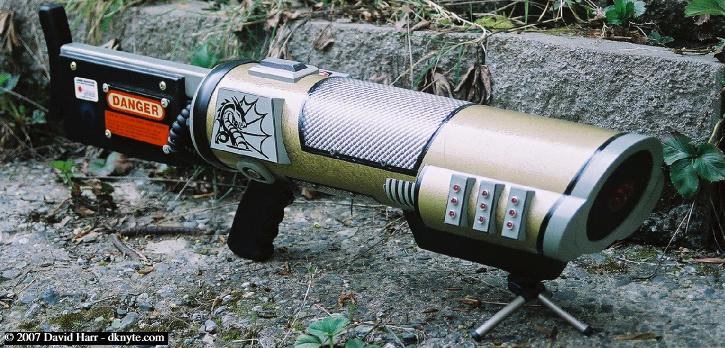
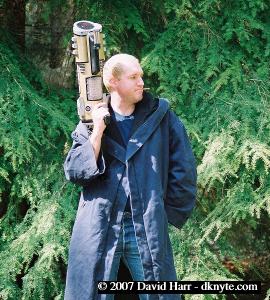
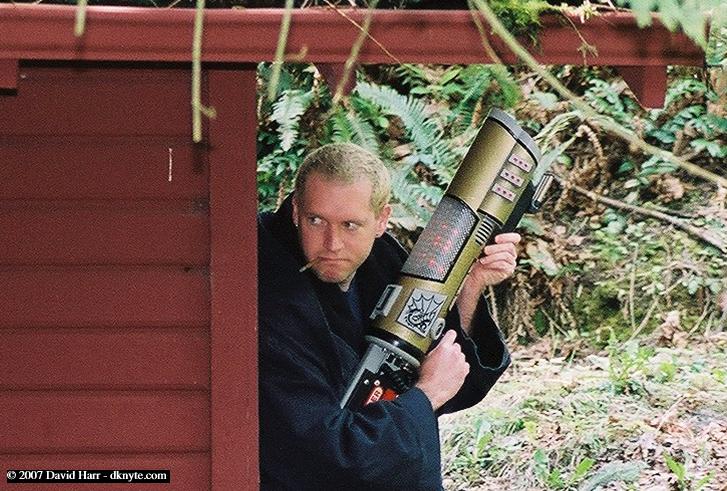
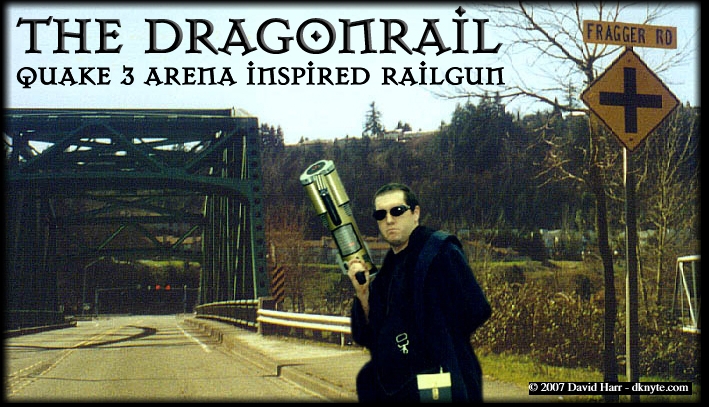
My buddy Rob Good at Black Hills Cabinet and Fixure and I created this one-off model of a Railgun. Inspired after the Railgun from the games Quake II and Quake III arena by ID software, this puppy is made of plastic, wood, a cardboard tube and a bunch of internal electronics. Following my design, the total build from concept to finalization took about 6 months.


In the following, I will describe some general principles of the railguns' construction both inside and out. No schematics are shown nor detailed images of the inside. Features of the DragonRail are as follows...

User controllable visual effects
Rubber hand grips
Laser pointer arperature
Built-in display stand
Vibration feedback
Audio rail-hum and shooting sound effects
Stock mounted & external slung power cells
 
Length, height and width: 32.5" x 8.5" x 7.5"
Railgun weight w/ stock power cell: apprpx. 10Lbs.
External power supply: 3Lbs.

The Upper and Lower Visual Effects Explained


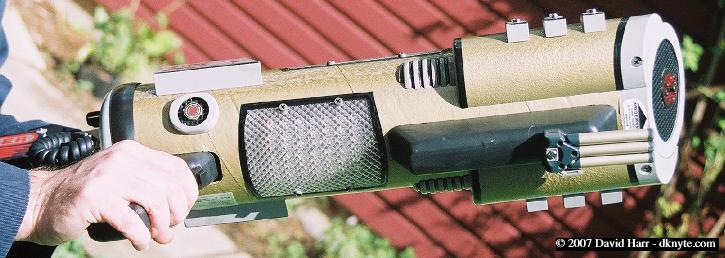
The upper visual effects array consists of 13 rows containing 146 red high-brightness LED's total. They are staggered such that the outer most rows have 10 LED's per row, then 3 rows of 11 LED's each side then 5 rows of 12 LED's in the top-most center. These rows are made active by both a 7x counter and a 6x counter. These counter control the switching of transistors that activate each row one at a time per relative said counter. They also activate in the opposite direction of each other so the LED's appear to cross each other. The following example illustrates how the rows are interleved. The bold numbers are controlled by the 7x counter and the italic ones by the 6x counter.


10 11 11 11 12 12 12 12 12 11 11 11 10

Bold: 7x Italic: 6x


The data for each of the counters is supplied by a 556 timer. A 556 is an IC that contains two 555 timers in one discrete chip. One of the timers is at a set speed and the other is controlled by a potentiometer that the user can control. The timers' output might be considered "dirty." This dirty signal, which is on purpose, gives the appearance of randomness to the on/off states of the LED's. The output of each timer is then fed into a series of shift registers to move the LED signals linerally towards the user. A decade counter controls the speed of the shift registers which is user controlable.

The lower visual effects array consists of 7 rows of 7 LED's for a total of 49. They are simply tied into the 7x counter and its shift register of the upper visual effects.

The Front Visual Effects, Laser, Speaker and Vibration Motor


The front of the railgun has a cluster of 8 LED's with a laser pointer in the center. When the guns' trigger is pulled, the 8 LED's go blank and the laser pointer activates. The 8 LED's and the laser are suspended in the center of the speaker grill which protects the speaker.


The speaker plays the audio from two recordable IC's. While the railgun is on, a custom looped hum is played to simulate the power of the weapon model. When the trigger is pulled, not only does the aformensioned forward LED's and laser do their thing but a shooting sound is played.


Also, when the trigger is pressed, a 12V motor with a counterweight spins up and causes the entire railgun to vibrate slightly.


There are 9 LED's on the front trim panels on both sides. They just stay on.


The Control Panel of the Railgun

The back of the railgun contains the control panel that houses the following...

 
Main power switch (obstructed from view)
Main power LED (shown)
Toggle switch for the looping railhum (shown)
Visual effect linear speed control dial (shown)
Visual effect lateral speed control dial (shown)
Power cell input port (shown)
Alt power input port (shown)

The Power Sources


One 12V lead acid battery is housed on the stock of the railgun. Another is supplied from a seperate matching power cell case that can be carried ofer the shoulder. Both are connected by a power cord to a port on the rear control panel.

An external power cube can also be used if portability is not needed.


Early Construction Images

Some innards of the railgun.

The outer shell installed.

The front bezel

These are some older images during construction. The picts were made with a crappy cam so pardon the clarity. You can make out the basic early construction progress.


The upper left image is the inside of the gun. This is the main inner frame that is also the mount for the electronics. In the center is the LED array for the visual effects. Towards the front of the array (image left) is the visual effects control board. that houses the TTL logic. Rearward of the array (image right) is the power regulation board.


The upper right image is the raw housing installed over the frame. You can see that the slot is cut to allow the LED's to shine on thru. A clear plastic bezel is cut to cover that opening during final construction.


The final image to the left is the front bezel, laser armature and speaker grill. A speaker is installed behind the grill and the front laser assy. appears to float in the center.

This site requires the use of frames. If you came to this page and there's no button field to the left, try returning to the site thru the front door at www.dknyte.com.